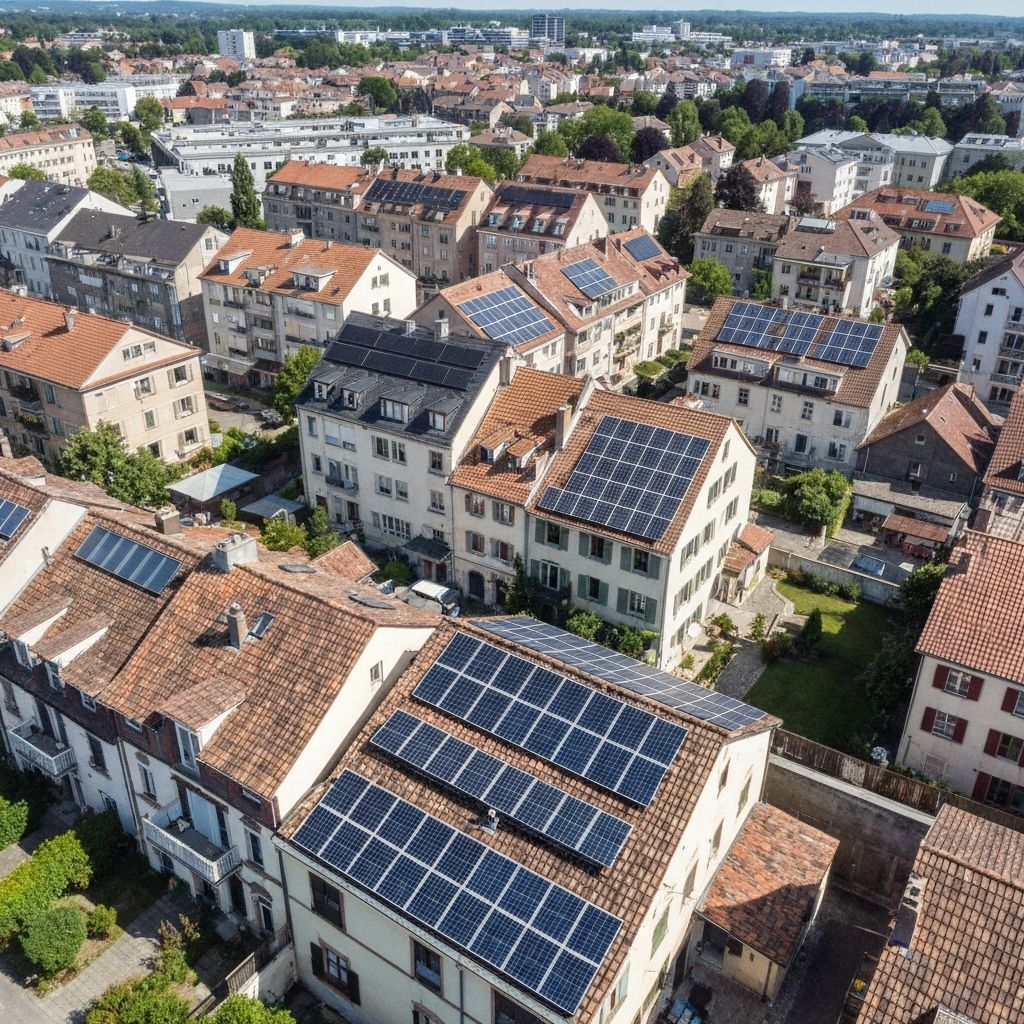
Why solar roofs have not scaled like rooftop PV
Standard rooftop solar became a mass-market product because it solved the economics first. Solar roofing, despite its architectural appeal, has often remained trapped in a higher-cost, custom-construction model.
Core thesis
- Rooftop PV scaled through standard modules, standard workflows and financeable payback periods.
- Solar roofing has often used custom modules, construction-heavy installation and premium-positioning arguments.
- To scale, solar roofing must become a bankable energy-producing roof layer - not only a beautiful architectural feature.
Global solar PV is no longer an emerging technology. It is one of the fastest-scaling energy technologies in the world. IEA PVPS reported that global PV additions reached between 553 GW and 601 GW in 2024, taking cumulative installed PV capacity beyond 2.2 TW at the beginning of 2025. The International Energy Agency expects solar PV to represent nearly 80% of global renewable electricity capacity expansion between 2025 and 2030, driven by low module costs, efficient permitting and broad social acceptance. [1][2]
Yet one segment has not followed the same curve: solar roofing.
Building-integrated photovoltaic roofs, often called BIPV roofs or solar roofs, have been available for years. The proposition is attractive: a roof surface that generates electricity, removes the need for visible rack-mounted panels, and offers a cleaner architectural result. But while rooftop PV has become a mainstream energy product, solar roofing has largely remained a niche. The reason is not that customers dislike the concept. It is that the category has struggled to compete on the metric that matters most in solar: payback.
The market asks about payback, not invisibility
For most solar customers, the first question is not whether the system is invisible. It is whether it pays back.
That question has shaped the growth of rooftop PV. A standard PV system can be priced, financed, installed and modelled with relative confidence. Customers understand the equation: upfront cost, electricity savings, loan or lease payments, payback period and long-term return.
Solar roofing has often been sold with a different set of arguments: aesthetics, architectural integration, premium design and visual discretion. These are real benefits, but they are not enough to create a mass market. They are nice-to-have arguments.
Mass adoption requires a different logic. It requires a product that can fit into mainstream financing structures - loans, leases, rental models and power purchase agreements. Once the installed cost moves too far beyond standard PV, the available financing models narrow quickly. A 5-10 year payback period is understandable for homeowners, commercial property owners and lenders. A 15-20 year payback period becomes harder to finance, harder to explain and harder to sell.
Rooftop PV won through standardization
The rapid growth of rooftop PV was not only a story of better technology. It was a story of standardization.
Modules became mass-produced. Mounting systems became repeatable. Installers learned standardized workflows. Banks and leasing providers learned how to underwrite the asset. Customers learned what to expect.
Fraunhofer ISE data shows how dramatic the cost curve has been. In Germany, a typical 10 kW to 100 kW rooftop PV system cost around EUR 14,000/kW in 1990. By the end of 2024, such systems cost less than 9% of that level. Module prices have also followed a steep experience curve, falling by around 25.7% with each doubling of cumulative global production. [3]
That is the benchmark solar roofing has had to compete with. And it has often moved in the opposite direction.
Instead of using the global scale of standard PV modules, many solar roof systems have relied on proprietary modules, unique dimensions, bespoke formats or closed product ecosystems. That may create a differentiated product, but it also weakens the economic case. Custom modules are produced in smaller volumes. They often require separate certification work, dedicated supply chains and additional technical validation. The result is a product that may look better, but starts from a higher cost base before installation even begins.
The custom-module problem
One of the core questions for the solar roofing sector is simple: why use a custom PV module if high-quality glass-glass modules are already available at global scale?
Standard PV modules are cheap, tested, certified, bankable and widely available. They are the component around which the global solar industry has scaled.
A custom solar roof module can make sense in premium architecture. It can solve specific design constraints. It can create a unique brand position. But for the mass market, custom hardware is usually a cost penalty.
The U.S. Department of Energy has identified several barriers to BIPV deployment, including cost, technical complexity, certification, permitting and the need for better coordination between the building and solar industries. Its summary also notes that non-standard-size PV modules do not yet have the economies of scale associated with conventional panel systems, keeping costs high. [4]
That is the structural challenge: solar roofing has frequently tried to scale through uniqueness, while rooftop PV scaled through standardization.
Three jobs instead of one
The second major barrier is installation.
A standard rooftop PV system is relatively simple. The existing roof remains in place. A PV team installs the mounting, modules, cabling, inverter and commissioning package. One workflow. One primary team. One familiar installation model.
Many solar roof systems have required a much more complex sequence: first, the old roof is removed; then, a new roof substrate or waterproofing layer is prepared; then, the solar roof system is installed.
This means one project can bring together demolition workers, roofers and PV installers on the same workfront. Each trade has different priorities, tools, responsibilities and risk assumptions.
The roofer thinks about water, flashings, speed and roof geometry. The PV installer thinks about modules, strings, grounding, inverter design and electrical safety. The demolition team simply needs to remove and prepare the site. Combining these workflows increases coordination cost and increases the risk of delays.
NREL research reported by pv magazine found that roof-integrated PV can be fast in new construction, with installation times 44% lower in that study, while retrofit installations showed a smaller 7% labor reduction compared with standard solar. The same coverage noted that BIPV has not kept up with expected price declines and that total installed costs can still exceed conventional PV. [5]
That observation goes to the heart of the problem. Solar roofing is not only competing against another product. It is competing against a simpler job.
Designed by PV logic, not roofing logic
Many solar roof systems have also been designed from a PV perspective rather than a roofing perspective. That distinction matters.
PV design often optimizes for wattage, module cost, electrical performance and EUR/W. Roofing design optimizes for speed, water management, repeatable details, tool simplicity, installer movement and the number of components handled on the roof.
A roofing product must be fast. It must be obvious. It must work in bad weather windows, on imperfect buildings, with limited space and under time pressure. It should not require installers to handle dozens of small parts or switch between multiple screw bits, tools and special procedures.
If a system requires excessive component sorting, too many unique fixings, complex sequencing or constant technical supervision, it may be a good engineering system - but it is not yet a scalable roofing product. This is where many solar roofs have struggled. They have been optimized for product uniqueness and manufacturing logic, not for the practical logic of a roofer on a sloped surface.
Installed cost matters more than module cost
Solar roofing companies have often focused heavily on manufacturing cost and watt-level pricing. But customers do not buy modules in isolation. They buy an installed system.
If a product saves cost in the factory but adds days on the roof, the customer does not see a saving. The cost has simply moved from manufacturing to labor.
For rooftop PV, the industry spent years reducing both product cost and installation complexity. For solar roofing, the system cost can be pulled upward by custom modules, roofing preparation, additional waterproofing, specialist labor, slower installation, and more complex responsibility between trades. That combination makes it difficult to reach the payback periods required for mainstream financing.
Financing is the real bottleneck
The consequence of higher installed cost is not only a higher price. It is a weaker finance case.
When payback stretches toward 15-20 years, many mainstream financing models become less attractive. Banks, leasing providers and PPA companies prefer assets with predictable output, standardized installation risk and shorter payback windows.
This is why rooftop PV scaled: it became a financeable asset.
The same has not always been true for solar roofing. Too often it has been treated as a premium construction upgrade rather than an energy asset with clear cash-flow logic. For solar roofing to grow beyond niche applications, the category must shift from "beautiful roof product" to "bankable energy-producing roof layer." That means reducing the cost gap with standard PV, simplifying installation, using bankable components and creating workflows that lenders and installers can understand.
What has to change
Solar roofing can still become a mass-market category, but only if it changes its operating logic.
The winning model is unlikely to be based on maximum uniqueness. It is more likely to be based on standard PV modules, roofing-style installation, fewer components, faster workflows and compatibility with mainstream financing.
In practical terms, that means:
- using standard, bankable PV modules where possible;
- avoiding unnecessary custom module formats;
- reducing roof removal and reconstruction requirements;
- designing the system around roofer logic, not only PV engineering;
- cutting the number of components and tools required on the roof;
- creating clear responsibility for waterproofing, electrical safety and warranty;
- keeping installed cost low enough to support loans, leases, rental models and PPAs.
The point is not to make solar roofing less attractive. The point is to make it financeable.
The opportunity ahead
The solar roofing market has not failed because the idea is weak. It has struggled because the execution has often been too expensive, too custom and too construction-heavy.
Rooftop PV grew because it answered the customer's central question: when does it pay back?
Solar roofing must now answer the same question.
A beautiful roof is valuable. An invisible PV system is attractive. But the mass market will not scale on aesthetics alone. The next generation of solar roofing needs to combine three things: the economics of standard PV, the installation logic of roofing, and the visual quality of BIPV.
If it can do that, solar roofing may finally move from premium niche to mainstream building technology.
Holaroof positioning
Holaroof follows this shift by positioning the solar roof not as a closed custom-module product, but as a system built around standard framed PV modules, metal battens, flashings, filler panels and roofing-style installation logic. Its own technical materials describe the system as compatible with various PV module types approved for in-roof use, with use cases including new roofs, retrofit applications, carports, pergolas and facades. [6]
The key commercial argument is therefore not only aesthetics. It is the ability to reduce unnecessary roof replacement work, use standard PV economics, and make the solar roof compatible with financing models such as loans, leasing, rental and PPA structures. That is the difference between a premium architectural feature and a scalable energy product. [7]
Sources and references
- [1] IEA PVPS - Trends in Photovoltaic Applications 2025
- [2] International Energy Agency - Renewables 2025: Renewable electricity
- [3] Fraunhofer ISE - Photovoltaics Report, October 2025
- [4] U.S. Department of Energy - Summary: Challenges and Opportunities for Building-Integrated Photovoltaics
- [5] pv magazine - Roof-integrated solar takes 44% less time to install, says NREL
- [6] Holaroof S.L. - Pro Roof Manual v1.0, internal draft
- [7] Holaroof - USP and risk materials, internal draft
Editorial note: This is a draft article written in a solar trade-media style. It is not affiliated with pv magazine or any other publication.
Ready to Learn More?
Download our complete technical documentation or contact our team to discuss your project requirements.