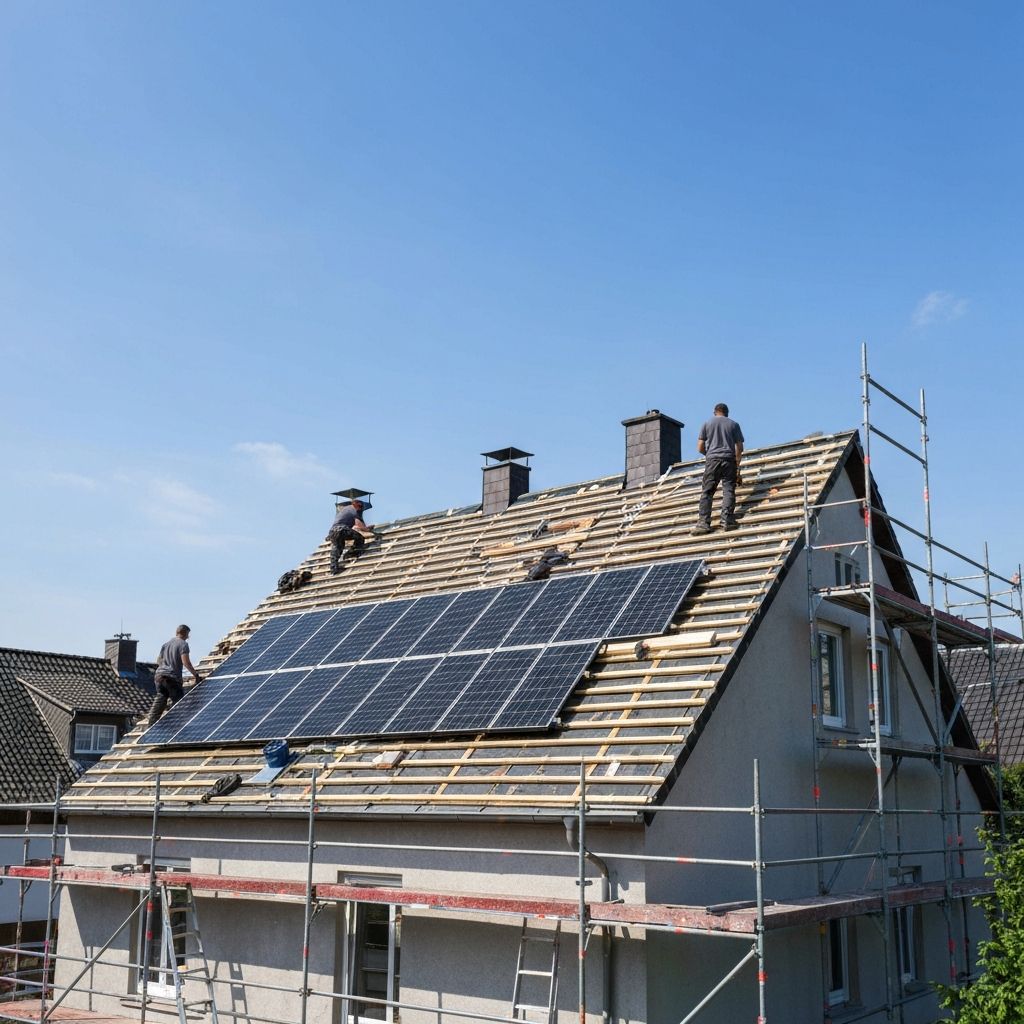
Solar roof renovation does not have to begin with demolition
Holaroof and the logic of fewer actions, faster installation and shorter payback
The first question in solar roof renovation should not be "Which new roof do we build?" It should be "Is the existing roof good enough to keep?" If the existing roof is dry, structurally sound, sufficiently watertight and risk-assessed, Holaroof can add a new energy-generating roof layer above what already works.
The missing space between BIPV and rooftop PV
The solar roofing market has mostly been split into two categories.
On one side is BIPV: building-integrated photovoltaics. The promise is strong. A roof should not be a passive surface. It should protect the building and generate electricity at the same time. But in renovation, BIPV has often meant removing the existing roof and rebuilding it as a solar roof.
On the other side is conventional rooftop PV. It is familiar, widely financed and comparatively simple. The panels are added above the existing roof. The roof stays in place, but the PV system does not become a new roof surface. It is an energy system above the roof.
Holaroof is designed for the space between these two logics.
It is not simply another BIPV roof-replacement product, and it is not only a standard panel mounting system. Holaroof uses standard framed PV modules to create a new energy-generating roof layer above a suitable existing roof.
For renovation, the central question is simple: is the existing roof good enough to avoid demolition?
If the answer is yes, the economics of the project change.
Suitability comes first
Solar roof renovation is not suitable for every building. This must be the first filter, not a small disclaimer at the end of the project.
Holaroof is not a way to hide a failing roof. If the existing roof is leaking, wet, rotten, structurally weak or at the end of its service life, the problem must be solved before a solar layer is added. Repair, partial opening or full replacement may be necessary.
But if the existing roof is dry, sufficiently watertight and structurally suitable, removing it may not create value. In some cases, it destroys value.
A proper assessment has to look at the whole situation: structural strength, fixing points, moisture risk, hidden damage, ventilation, drying paths, fire behaviour of the existing layer, local building rules, electrical requirements and grid connection. This is not bureaucracy for its own sake. It is the basis of the whole renovation logic.
If the roof is not suitable, fix it first. If the roof is suitable, much of the work that normally makes solar roofing slow and expensive can be avoided.
The real cost is often the number of actions
In solar roof renovation, the largest cost is not always the PV module. Often, the largest cost is the number of actions required before the system can produce its first kilowatt-hour.
When the old roof is removed, the project gains demolition, waste handling, temporary weather protection, a new underlayer, roofing work, PV installation, electrical work and coordination between different trades. All of this happens before energy production begins.
That is why many solar roof projects stop behaving like energy projects and start behaving like construction projects.
Holaroof follows a different route. Where the existing roof is technically suitable, a new energy-generating roof surface can be added above it without making demolition the default starting point.
Fewer actions mean shorter installation time. Shorter installation time means less weather risk, less labour risk and less coordination risk. Lower risk improves the finance case. And a better finance case is what moves solar roofing closer to the mass market.
Payback improves when fewer things need to happen before the system starts producing energy.
Renovation does not have to open the building envelope
A full roof replacement opens the building envelope. That creates weather exposure, schedule pressure and the need to protect the building while work is underway.
If the existing watertight roof remains in place during installation, the renovation is less disruptive. The building is not exposed in the same way as during a full roof replacement. This matters for homes, commercial buildings, schools, hotels, warehouses and agricultural buildings that need to remain usable during the works.
The project still requires proper structural, fire-safety and electrical checks. But the nature of the project changes. Instead of full roof reconstruction, the customer can, in suitable cases, think about adding an energy-generating roof layer.
That is easier to explain, easier to schedule and often less intimidating for the customer.
Standard PV modules change the economics
Rooftop PV scaled because it was built around standard modules, standard workflows and understandable payback.
Many BIPV systems moved in the opposite direction: custom modules, special dimensions, proprietary ecosystems and construction-heavy installation logic. The result can be architecturally clean, but it is often expensive and harder to finance in renovation.
Holaroof takes a different assumption. The aim is not to create a new expensive solar module. The aim is to use the economics of a standard framed PV module and give it a roof function.
That matters because the existing building stock is large, but price-sensitive. A solar roof that wants to compete with conventional rooftop PV has to move closer to standard PV economics, installation speed and financeability.
The value is not created by locking the customer into a special module. It is created by making standard PV work as part of a roof system.
A real renovation roof is more than a panel field
Existing roofs are rarely perfect rectangles. They have ridges, hips, valleys, eaves, wall junctions, penetrations, chimneys, roof windows, access routes, snow guards and transitions to other materials.
If a solar roof system only solves the panel field, too much work is left to be improvised on site. On-site improvisation is slow. It creates mistakes. It blurs responsibility.
Holaroof treats the solar roof as a roofing system, not only as a PV array. In renovation, this is critical. The more details are solved in the system, the fewer things installers need to invent on the roof.
Less improvisation saves time. Time saved on the roof improves the economics of the whole project.
Permitting logic may be closer to rooftop PV
Permitting depends on the country, the municipality, the building type and the details of the project. For that reason, no solar roof supplier should claim that no permit is needed.
The better point is different.
Where the existing roof remains in place, the building envelope is not opened and the additional load is comparable to conventional rooftop PV, the project may, in suitable cases, be closer in logic to a rooftop PV installation than to a full roof reconstruction.
That matters because permitting complexity is not only a legal issue. It is also a sales and time issue.
The more a project looks like a full construction intervention, the more uncertainty, documentation and delay can enter the process. The more it looks like a controlled PV installation above a suitable existing roof, the easier it can be to explain to the customer and to project stakeholders.
Local building, fire-safety, electrical, grid-connection, planning and heritage requirements still apply. But project category matters.
Heritage and visually sensitive buildings
Heritage and architecturally sensitive buildings are difficult for solar.
Conventional rooftop PV can be too visible. Classical BIPV can be too invasive if it requires removing the existing roof or replacing original materials.
A layered renovation logic may create a better starting point in some cases. If the original roof layer can remain in place and a reversible energy-generating layer is added above it, the intervention may be less destructive than a full roof replacement.
This does not mean automatic suitability. Heritage approval, visual requirements, structure, fire safety and local planning rules must always be reviewed case by case.
But for sensitive buildings, the value may be exactly this: less demolition, less contact with original material and more reversibility.
Fire safety must be checked before speed
Fast renovation must not mean hidden risk.
A solar roof is an electrical system within the roof layer. The complete build-up must be assessed: the existing roof, the new solar layer, cables, connectors, ventilation, separation layers and fire behaviour.
If the existing roof covering is combustible and remains beneath the electrical zone of the new solar roof system, the risk must be mitigated. The combustible layer should either be removed or separated from the system with a suitable non-combustible or fire-resistant underlay or separation layer.
This is part of the suitability filter. A good renovation product does not promise the same answer for every roof. It makes the decision clear before installation begins.
The same logic also applies to newbuild
Although the strongest renovation benefit is avoiding unnecessary demolition, the same logic also applies to newbuild projects.
In a new building, there is no existing roof to keep. The question is duplication. Why build a conventional roof first and then install a separate PV system on top of it?
If the roof and PV system are designed as one surface from the beginning, materials, work stages and responsibility boundaries can be reduced.
So the principle works in both directions. In newbuild, Holaroof can reduce duplication. In renovation, Holaroof can reduce unnecessary demolition. In both cases, the goal is fewer actions before energy production.
Conclusion: solar roofs must win on time
The mass market for solar roofing will not be created by better design alone. It will come when the project becomes simpler, faster and easier to finance.
Holaroof renovation logic starts with the existing roof. If the roof is not suitable, it must be repaired or replaced. If it is suitable, the project does not need to begin with demolition by default.
That is the difference: less demolition, fewer work stages, lower weather exposure, less permitting complexity and more capital directed toward an energy-producing asset.
Holaroof is not simply a panel above a roof, and it is not only a classical BIPV roof replacement. It is a standard-module-based solar roof system that can reduce duplication in newbuild and avoid unnecessary demolition in suitable renovation projects.
If solar roofing wants to reach the mass market, it has to win on time.
Holaroof begins with that question: first check whether the existing roof is suitable - and if it is, do not demolish what does not need to be demolished.
Note: This article is for market education and does not replace project-specific structural, fire-safety, electrical, permitting, heritage or local building-code assessment.
Ready to Learn More?
Download our complete technical documentation or contact our team to discuss your project requirements.