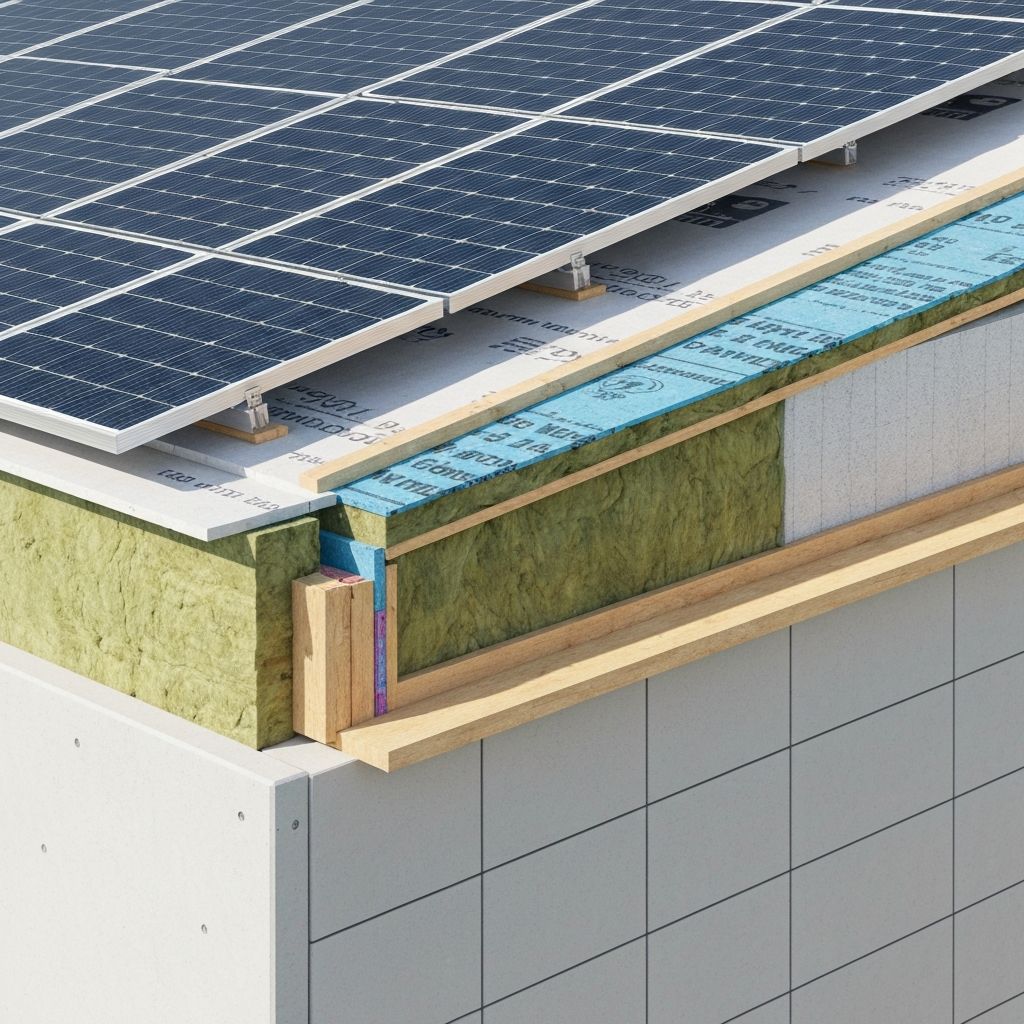
Can in-roof solar and conventional roofing use the same underlayment standard?
In-roof solar has largely solved the visual problem of rooftop PV. The next question is whether the layer beneath the module is still being designed for passive roofing - or for an active electrical roof.
Opinion
In-roof solar has helped solve one of rooftop PV's most visible problems: appearance.
Conventional rooftop PV has scaled quickly because it is simple, standardized and economically understandable. But for many homeowners, architects and property developers, the visual issue remains. The panels sit above the roof as a separate layer. They work well, but they are not truly part of the roof.
In-roof systems were largely born from that need. The module is brought into the roof plane. An active solar field is fitted into a passive roof covering. The result is a cleaner roof line and a more architecturally acceptable surface.
That is an important step forward.
But as the market grows, a new question appears: when PV becomes part of the roof surface, is the whole roof build-up still being designed according to passive roofing logic - or according to active roof logic?
Passive roofs and active roofs are not the same thing
A passive roof protects the building from the weather. Its main tasks are water, snow, wind, condensation, mechanical stability and durability. A conventional roof covering may be tile, metal, bitumen, shingle or another material. It does not produce electricity. It does not carry DC cables. It does not contain connectors, plugs or electrical fault scenarios.
An active roof does more.
An active roof protects the building and produces electricity. That means the roof layer contains PV modules, DC cables, connectors, voltage, heat load, maintenance requirements and electrical risk. A solar roof is therefore not simply another roofing material. It is a building system and an electrical system in the same layer.
This changes the role of the underlayment.
In a conventional roof, underlayment is often a secondary water barrier. It helps protect the structure from incidental water, wind-driven rain or condensation. In a solar roof, that may no longer be enough. If the outer roof layer is an active electrical system, the layer beneath it has to perform more functions.
It has to support ventilation. It has to tolerate higher temperatures. It has to allow controlled cable routing. It has to help limit fire spread. It has to separate the electrical zone from combustible construction materials. It has to support inspection and maintenance over the life of the system.
At that point, it is no longer just underlayment. It becomes part of the technical safety layer of an active roof.
In-roof solar has changed the nature of the roof
The logic of in-roof solar is simple: part of the conventional roof covering is replaced by PV modules. On the same roof plane, passive roofing material and active electricity-generating areas may sit side by side.
Visually, this works well. The roof looks more unified. The solar module no longer appears as an object added afterwards, but as part of the roof itself.
Technically, however, a new hybrid is created.
Two different logics meet on one roof surface: passive weather protection and an active electrical system. If the layer beneath, the ventilation strategy, the cable route and the fire behaviour are still solved only according to passive roof assumptions, the real system may be more complex than its appearance suggests.
This is not a criticism of any specific technology. In-roof systems have developed quickly in recent years and have helped bring solar energy into buildings in a cleaner architectural form. But as the category grows, the expectations placed on these systems also change.
A solar module inside the roof plane is no longer only a visual element or a replacement for conventional roofing. It is part of an active electrical roof layer.
That means the next discussion should move from appearance to system performance: what kind of substructure, ventilation, cable management and fire-safety logic is suitable for a roof that is no longer only passive weather protection?
Appearance has been improved. Now the layer beneath the module must be solved
In-roof solar has made PV more visually acceptable. That matters, because appearance has been a real barrier for many customers.
But the next stage of solar roof development will not happen only on the visible surface. It will happen beneath the module.
That is where air moves. That is where DC cables are routed. That is where connectors and plugs sit. That is where heat may accumulate. That is where moisture may remain. That is where the boundary between the electrical system and the building structure is located.
If this layer is not designed according to active roof logic, part of the risk remains hidden.
For a conventional roof, the primary question is: where does the water go? For a solar roof, additional questions appear: where does the heat go, where do the cables go, what happens during a fault, how does a service technician gain access, and what material sits beneath the electrical zone?
These questions should be part of the system from the beginning, not solved later as site-specific improvisation.
Ventilation is not only about energy yield
PV modules perform better when they are not overheated. That is well understood. But in an active roof, ventilation is not only an energy-yield issue.
It is also a safety, ageing and long-term reliability issue.
The zone beneath a module can be warmer, more humid and harder to access than a conventional roof layer. If air movement is insufficient, cables, connectors, seals, membranes and other materials may operate in a harsher environment than originally expected. If moisture cannot dry out, a second risk layer is added.
Passive roof ventilation logic does not automatically fit beneath an active PV layer. An active roof needs designed air paths, not accidental air gaps.
Cable management must become part of the roof
In PV systems, small cable-management errors can become major problems over time. A loose cable, a poor connection, abrasion, an incorrect penetration or a plug that is difficult to inspect may not create a visible problem immediately. But a roof is a 25- to 30-year environment.
In an in-roof system, a DC cable is not just an electrician's detail. It is located inside the roof layer.
For that reason, the cable route should be part of the roof design. DC cables and connectors should be mechanically protected, fixed, ventilated, drained, separated from combustible materials and as inspectable as possible.
If cables are left to sit randomly beneath modules, the active roof layer becomes harder to assess. A solar roof should not depend on installer improvisation. It should provide a clear, repeatable and controlled cable path.
Fire safety is part of a wider roof build-up question
The active-versus-passive roof logic inevitably leads to fire safety, but this is not only a fire-safety discussion.
Fire safety is one part of a wider question: how does the complete roof build-up behave when PV becomes the roof covering?
Traditional roof fire logic often asks how the roof surface behaves under external fire exposure. A solar roof must also ask what happens if the risk begins inside the system: beneath a module, at a connector, along a cable, inside an air gap or near a penetration.
In that scenario, the material below the electrical zone becomes highly relevant. Is it timber? Bitumen? A standard membrane? A non-combustible separation layer? A metal substructure? A protected cable channel?
For an active roof, it is not enough that one component meets a requirement. The whole system matters: PV module, substructure, underlayment, air cavity, cables, connectors, penetrations, grounding, service access and fire-spread limitation.
That is why the underlayment in a solar roof should not be evaluated only as a waterproofing layer. It should also be considered part of the safety architecture of an active roof.
Serviceability should not disappear behind aesthetics
Visibility is important in roofing. If a metal sheet, tile, joint, penetration or gutter begins to age on a conventional roof, it can usually be seen and repaired.
In a solar roof, some critical elements may move below the visible surface. Cables, connectors, fixing points, air paths and water routes can become harder to inspect.
That means serviceability must be designed in from the beginning.
Can a single module be removed? Can a connector be reached? Is the cable route documented? Does the maintenance team know where the risk points are? Can the roof layer be opened locally during emergency response?
If the answer is unclear, the issue is not only maintenance. It is design.
An active roof must be serviceable. The more PV becomes part of the roof, the more important access becomes.
The next innovation may be in the invisible layer
Solar roof development has often been driven by the visible result. That is understandable. Customers see the roof surface, not the substructure. Architects judge line, colour and proportion. Sales often happen through images.
But long-term trust is created by what the customer does not see.
The layer beneath the module determines whether the system dries, ventilates, protects cables, limits fire spread, allows maintenance and works in a controlled way for decades.
That means the most important innovation in the next generation of in-roof solar may not be above the panel, but beneath it.
Not only better glass. Not only a cleaner frame. Not only a more uniform colour. But a better underlying logic for an active roof.
From passive roof standards to active roof standards
If solar roofs are to move from niche to mass market, the sector must do what rooftop PV did earlier: standardize risk and simplify trust.
Rooftop PV scaled because it became understandable. Modules became standardized. Mounting systems became standardized. Installers learned repeatable workflows. Financing providers gained an asset model they could evaluate.
Solar roofing needs the same kind of clarity, but at a different level.
It needs a standardized active roof build-up: how water, air, cables, heat, maintenance and fire safety are managed in one layer.
This does not mean all systems must be identical. But the principles should be clear.
An active roof should not be only a passive roof with PV added into it. It should be treated as a separately designed roof category.
Conclusion
In-roof solar has done important work. It has made solar on buildings visually cleaner and more architecturally acceptable.
But that is only the first step.
When PV becomes part of the roof surface, the whole roof becomes an active system. In that context, the layer beneath the module can no longer be treated only as a passive roofing backup. It must become a technical safety layer that supports ventilation, cable management, fire separation, serviceability and long-term reliability.
The next generation of in-roof solar will not be defined only by how well it disappears into the roof surface.
It will increasingly be defined by how well the hidden layer beneath it is designed.
An active roof needs active roof logic.
Editorial note: This article is an opinion-style market education draft. It does not replace project-specific structural, fire-safety, electrical, certification or local building-code assessment.
Ready to Learn More?
Download our complete technical documentation or contact our team to discuss your project requirements.